Most Georgia voters spend only a few minutes at the polls. ACLU of Georgia’s poll observers see something different: the full voting experience.
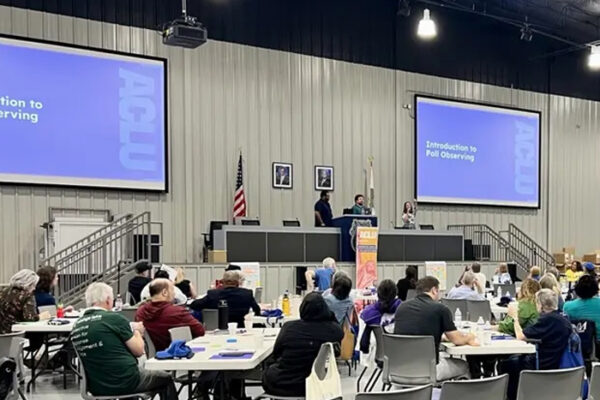
Through our Voter Access Project, volunteers watch for potential barriers, document what they see, and communicate concerns to staff and advocacy partners. In this Q&A, we spoke with Tori McFarland, VAP community organizer, about what it means to be an independent set of eyes and ears focused on ensuring every eligible voter gets to cast their ballot.
Check out our 2026 Voting Resource Hub for everything you need to plan to vote during early voting in October or on Election Day, November 3. Read the responses below and if you’re interested, sign up to be a poll observer here.
Over the coming months, we’ll follow several of our poll observers for early voting, when they spend time at polling places, and see what election protection looks like up close. Read about two of the observers in this blog.
When someone becomes a poll observer for the first time, what do you hope they understand by the end of their experience that they probably didn’t understand before?
I hope they come away understanding how important it is to have people on the ground who are focused specifically on the voter experience.
Before doing this work, you might hear about voting issues in the news or after an election, but observing gives you a different perspective. You see how something that may seem small — a long line, confusion about where to vote, an accessibility issue, or a voter unsure of their options — can become a real barrier if not identified. I want observers to understand that their role isn’t to run the election; it’s to be an independent set of eyes and ears focused on whether voters can access the ballot and to ensure concerns are documented and elevated when necessary.
What does a poll observer actually see and do during an election that most voters never get to see? What might surprise people about the work?
A poll observer sees the election from voters’ perspective throughout the day, not just the few minutes it takes one person to cast a ballot. They’re paying attention to things like whether lines are getting long, whether voters with disabilities can access the polling place, whether there is confusion about where or how someone can vote, and whether voters are encountering other barriers.
They document what they see and communicate with our team when something needs attention. What surprises people is that the work isn’t about going into a polling place expecting to find something wrong. A good observer may spend most of their shift simply observing and documenting. But when a voter encounters a problem, having someone who recognizes it and knows how to escalate it is essential.
Can you remember a moment from your experience managing or supporting poll observers when you thought, “This is exactly why this program matters”?
One moment that really sticks with me actually happened when I was a poll observer myself. I noticed that a polling location didn’t have adequate signage directing voters to where they needed to go. I escalated the issue to the voter protection hotline, and within about two hours, they put up proper signage so voters could more easily find the location.
That was one of those moments where I thought, “This is exactly why this program matters.” It wasn’t necessarily a huge or dramatic issue, but something as simple as inadequate signage can create a real barrier for a voter who is trying to find where they’re supposed to vote.
What makes an effective poll observer? Beyond knowing the rules, what qualities or instincts make someone good at this work?
I think the most important qualities are patience, attention to detail, good judgment, and the ability to stay calm. We don’t want someone to go into a polling place looking for a confrontation or assuming that everything they see is a problem. We want someone who objectively observes, documents exactly what happened, and communicates clearly with our team.
It’s also important to know the limits of the role. You’re there to observe and report, not to interfere with election administration or try to solve every situation yourself. Some of our strongest observers are the people who can recognize when something may affect voter access, gather the relevant information, and quickly get it to the people who can determine the appropriate next step.